

EncryptedSend
Share a password, API key, private note, or file as a one-time link that decrypts in the recipient's browser and erases itself the moment it's opened. Everything is encrypted on your device first: the server only ever holds scrambled ciphertext, and the key that unlocks it rides in the part of the link your browser never sends.
Built so the secret is only ever readable by two people.
You, and whoever you send the link to. Everything in between (the network, the server, us) only ever sees ciphertext.
Encrypted on your device
Your secret is encrypted in your own browser with OpenPGP (AES-256-GCM) before anything is sent. The plaintext never leaves your computer, and the server only ever stores ciphertext it can't read.
Burns after reading
The link works once. Open it and the secret decrypts, then it's permanently deleted from the server. Or set a view limit and an expiry (up to a week), and it goes whenever the first of those hits.
The key never reaches the server
The decryption key lives in the URL fragment (the part after the “#”, which browsers never transmit). That's what makes it zero-knowledge: the operator couldn't read your secret even if asked to.
Text or files
Send a quick password or note, or attach a file up to 30 MB, or both at once. Files are encrypted the same way as text: locally, in your browser, before a single byte is uploaded.
Ask for a secret, with receipts
Send a request link so someone can send a secret to you. A keypair is made in their browser, and the private half never leaves it. Turn on a read receipt to see when yours is opened: timestamps only, never identity.
Free: no accounts, no tracking
Nothing to sign up for, no cookies, no analytics profile following you around. Open the page, share a secret, close the tab. There's nothing in it built to know who you are.
A key that would take eons to guess.
Every share link carries a 22-character random key: about 131 bits of entropy. Guessing it isn't a realistic attack.
Encrypt, share, gone.
Three steps, and the sensitive part never touches a server in a form anyone could read.
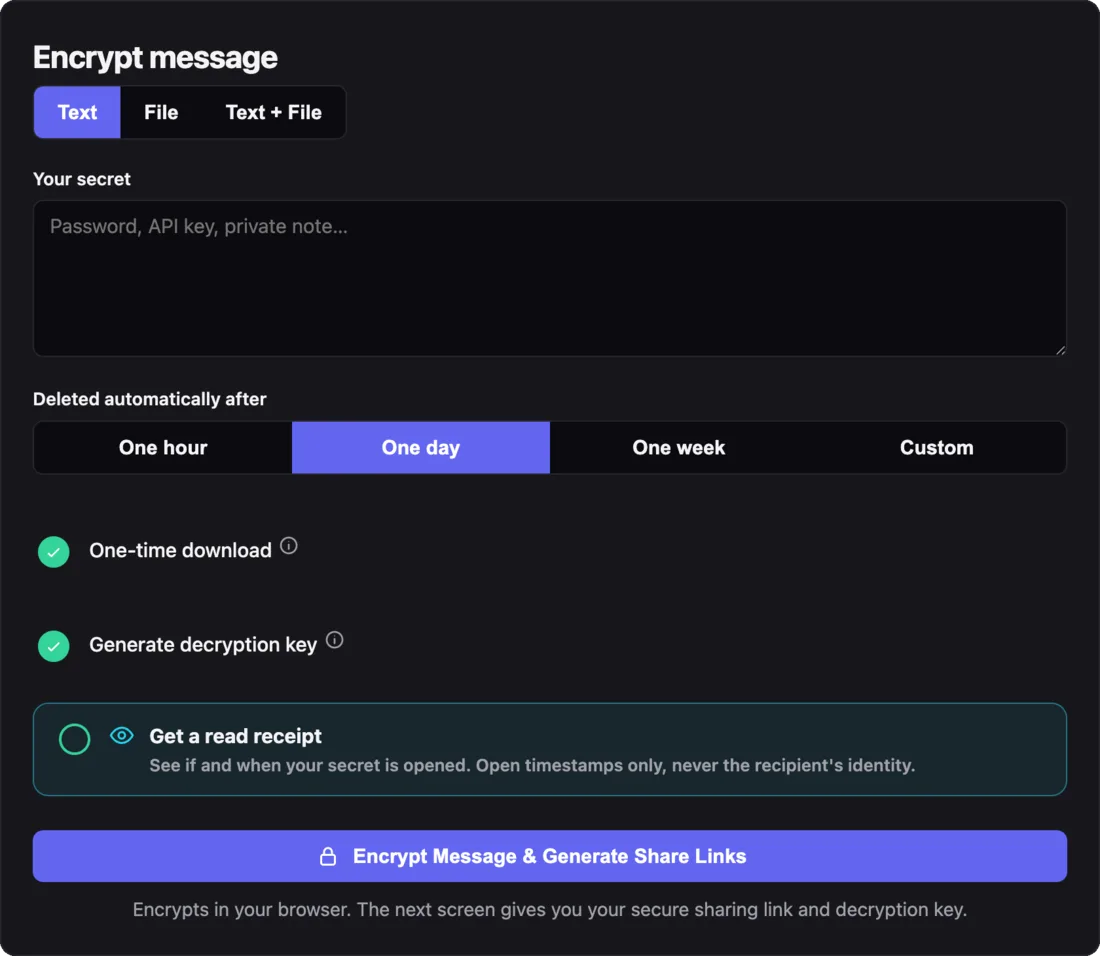
Encrypt in your browser
Type a secret or attach a file, then set the rules: when it expires and how many times it can be opened. It's encrypted on your device before anything is sent.
Share the one-time link
You get a self-destructing link, and, if you'd rather, a separate key to send through another channel. Pass it along however you normally would.
Read once, then it's gone
The recipient opens the link, it decrypts in their browser, and the secret is permanently destroyed on the server. Turn on a receipt to know the moment it was read.
Two ways to share it.
Encrypting hands you the link, and a choice about how carefully you want to split it up.
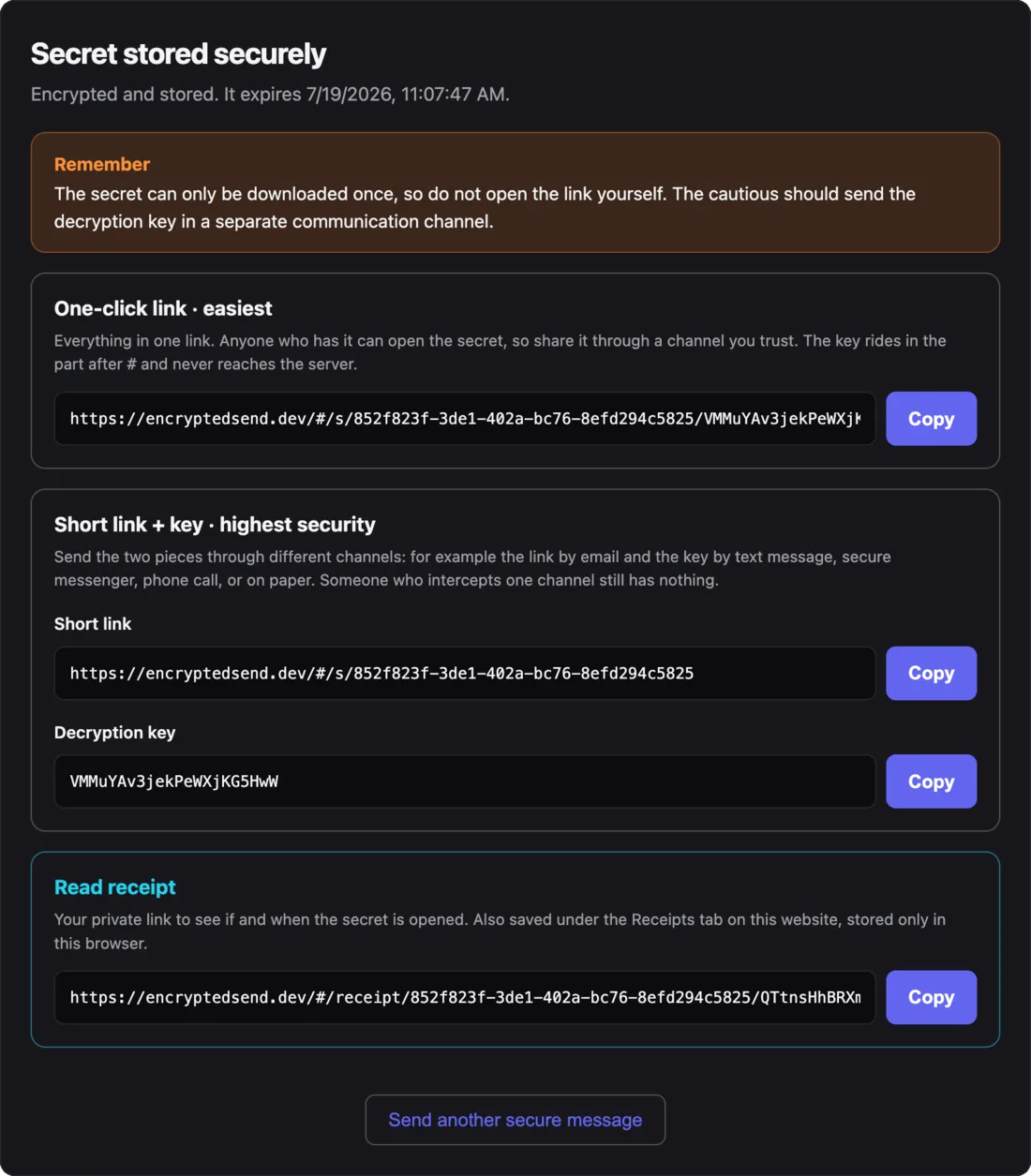
One-click link
Everything in a single link: the simplest thing to send. Anyone holding it can open the secret, so pass it through a channel you trust.
Short link + key
Send the two halves down different channels: link by email, key by text or over the phone. Intercepting just one of them gets you nothing.
Read receipt
An optional private link telling you if and when the secret was opened. Open timestamps only, never the recipient's identity.
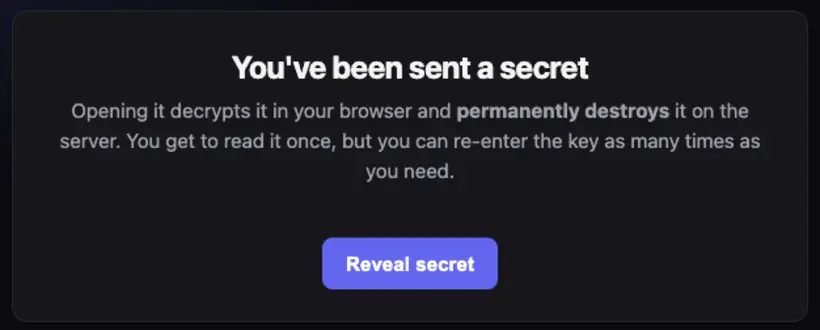
What the recipient sees.
One tap to reveal, and opening it is what destroys it. No account, no app to install, nothing to read twice.
Send your first secret.
Free, runs in any modern browser, works on your phone. No install, no account: open it and go. Built and run by Vigod Labs.
Common questions
Can Vigod Labs read what I send?
No. Your secret is encrypted and decrypted in the browser, and the decryption key stays in the part of the link that never reaches us. We only ever store ciphertext we can't open, which is what "zero-knowledge" means here.
What happens after it's read?
It's permanently deleted from the server the moment it's opened, or when it reaches the view limit or expiry you set, whichever comes first. Secrets can live at most a week. There is no "read it again."
Is the encryption something homegrown?
No. It runs on OpenPGP (AES-256-GCM): standard, hardened, open-source cryptography, executed in your browser. The app itself is proprietary, but the cryptography it relies on is open and auditable, not a scheme we cooked up. We're just standing on the shoulders of giants.